
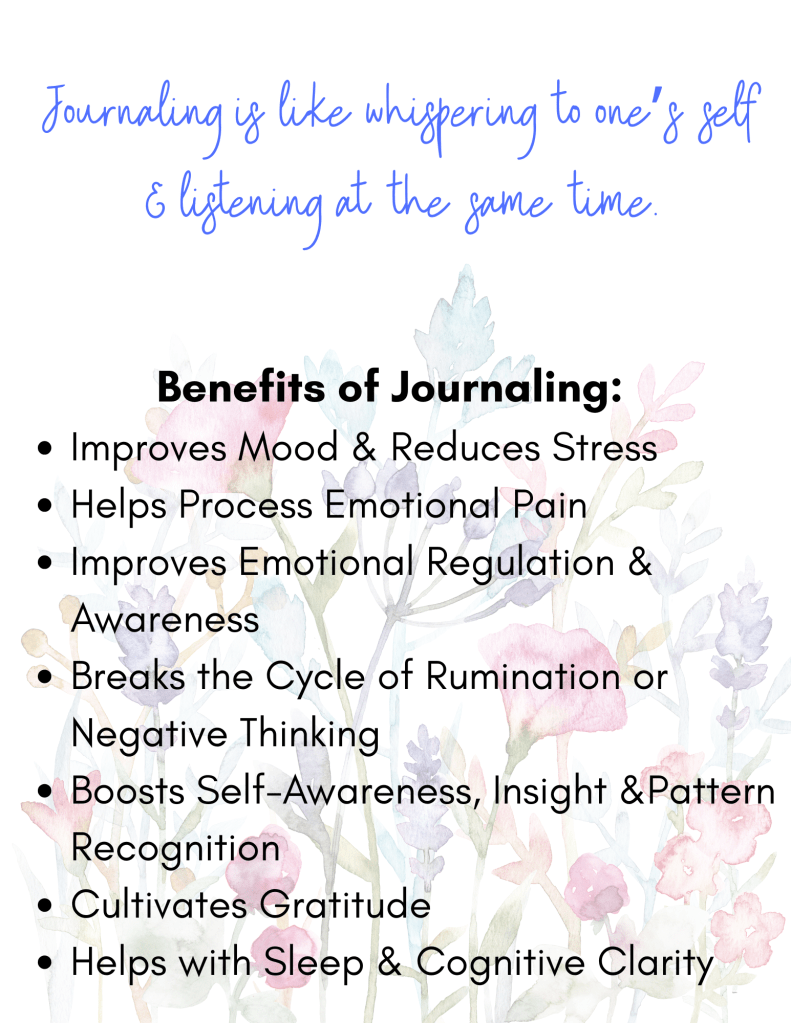
I often recommend journaling as a way to continue growth and healing between therapy sessions. Writing can offer something concrete to do with your thoughts and emotions—rather than simply sitting in them, ignoring them, or pushing them away. While journaling isn’t a magic fix or a solution to every problem, it can serve as a powerful stepping stone on the path toward healing, self-awareness, and lasting change.
Here are some daily journaling practices that support emotional regulation, self-awareness, and relational health — backed by research in mindfulness, positive psychology, and expressive writing. You can mix and match depending on your goals (stress relief, self-understanding, focus, etc.).
Morning Practices: Setting Intention and Focus
Three Intentions for the Day
“How do I want to show up today — for myself and others?”
Focus on qualities (calm, patient, curious) rather than outcomes.
Gratitude List (3–5 items)
Research shows that daily gratitude journaling increases optimism and decreases stress.
“If I could do one thing today to care for myself, it would be…”
Helps anchor self-regulation and balance before stress builds.
Visualization Prompt
“What does a grounded, peaceful version of me look and feel like today?”
Affirmation Writing
Write a short phrase that reinforces your values (e.g., “I can meet challenges with steadiness and compassion.”)
Evening/ End of Day Practices: Reflection and Emotional Processing
Three Good Things
End each day name three positive moments or small wins.
Evidence suggests this practice increases happiness and reduces depressive symptoms. (Seligman et al., 2005)
Emotional Check-In
“What emotions did I notice most today?”
“What do those emotions want me to know or need from me?”
This fosters emotional literacy and regulation (Siegel, 2012 – The Developing Mind).
Stress Reliever
Spend 5–10 minutes writing about one stressful moment — focusing not only on what happened, but what meaning you make of it. (Pennebaker & Chung, 2011)
Letting Go (especially before sleep)
“What am I ready to release before I rest tonight?” or reflecting on “what have I been holding onto today that no longer serves me?”
Encourages emotional closure and supports sleep.
Self-Compassion Reflection
“How did I care for myself today? How might I be kinder to myself tomorrow?”
Inspired by Neff’s work on self-compassion, linked to resilience and lower anxiety. (Neff, 2003)
Flexible Practices (Anytime)
Mind Dump / Brain Sweep
Write freely for 5–10 minutes to clear mental clutter. Don’t edit or censor.
This reduces cognitive load and rumination (Baikie & Wilhelm, 2005). This is especially helpful if you spend a lot of time overthinking things or need to externally process your thoughts.
Relationship Reflection
“Who helped me feel seen or supported today?”
“How did I connect (or disconnect) from others?”
Values Alignment Check
“Did my actions today reflect what matters most to me?”
Builds integrity and a sense of purpose.
Mood Tracker + Notes
Rate your mood (1–10) and jot a sentence about what influenced it.
Over time, you’ll identify triggers and supports for emotional health. This is especially helpful for understanding depression, bipolar disorder and other mood disorders.
Tips for Sustaining a Journaling Practice
Keep it brief/contain it: Even 5 minutes daily is enough to create measurable benefits. And containing the time helps it feel more do-able!
Consistency over perfection: A few honest lines matter more than eloquence.
Use structure: A recurring framework (e.g., “Gratitude, Emotion, Intention”) builds habit strength.
Habit stacking: Morning coffee, bedtime tea, or post-walk reflection work well.
Revisit occasionally: Look back every month to notice growth and recurring themes.

 Katie O'Brien, LICSW | LCSW - Telehealth Therapy Services | Relational Renewal